
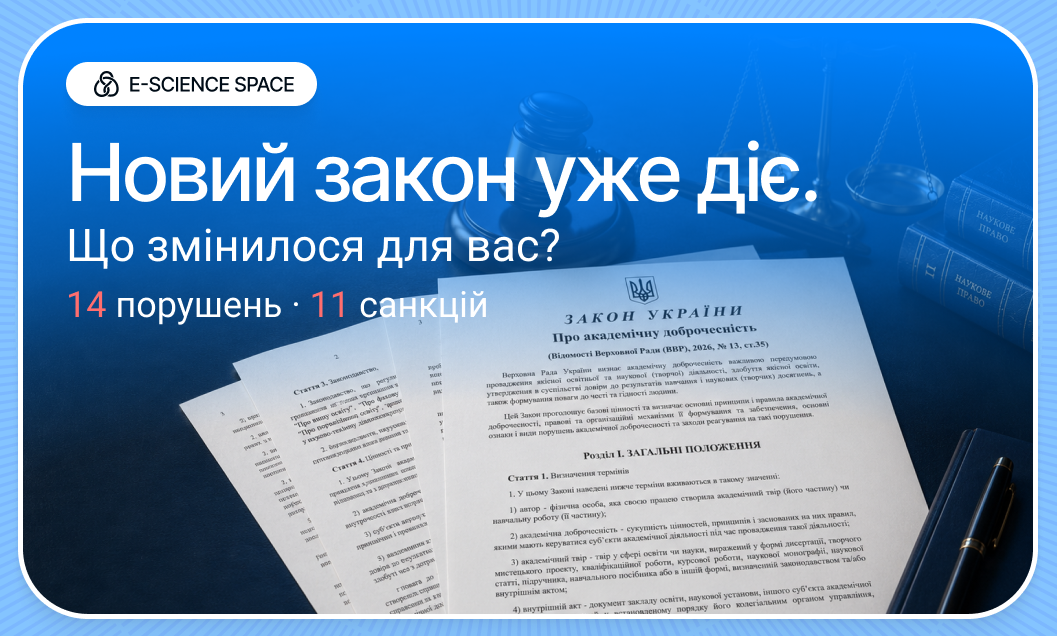
On 31 July 2026, the Law of Ukraine “On Academic Integrity” No. 4742-IX, adopted by the Verkhovna Rada on 18 December 2025, entered into force. This is the first standalone law on this issue in the history of Ukraine. Before, integrity was regulated by several provisions of education legislation and internal regulations of institutions.
September 2026 is the first academic semester to take place entirely under the new rules. For the first time, the law provides a closed list of violations and a closed list of sanctions, including the revocation of an academic degree and academic rank.
31.07.26
14
11
1–3 роки
Eight months passed between adoption and the first academic year under the new rules. Checks begin this semester.
8
SIGNALS
Eight signs that your publication is being prepared in a risky way
Let’s start with the practical side. This is a checklist for any offer you receive now — from an intermediary, colleague, or journal representative. We will examine the legal aspect below, but this is the list you should act on.
1
They offer you a ready-made text
Or “article development” based on someone else’s material. Under the law, this constitutes alienation of authorship by the provider and plagiarism on your part.
2
They offer you a co-authorship slot
Attribution of authorship even if no money is involved and it is “just helping a colleague”.
3
They guarantee publication in Scopus
With a fixed deadline. The decision is made by the editors and reviewers — no intermediary controls it.
4
They do not name the journal before payment
You cannot check whether it is indexed, whether it has been delisted, or whether it shows signs of being a predatory publication.
5
They accept a manuscript within a few days
Without substantive reviewer comments. Compromised peer review was the No. 1 reason in the structure of retractions in 2025.
6
They promise to “increase citations”
Through arranged reciprocal references. In JCR 2026, Clarivate has already excluded citations to and from retracted papers.
7
They say nothing about AI disclosure
The text was prepared with AI, but no one explained how to prepare the declaration. It is required by publishers and now also by Ukrainian law.
8
They recommend a journal outside the indexes
One that is neither in the updated Category B List nor in Scopus/WoS. There will be a publication, but it will not count.
If even one point matches, stop before paying. Once the article is published, fixing the problem is more expensive and takes longer: the median time from publication to retraction is about 562 days, and throughout those one and a half years the article works against your reputation.
14
VIOLATIONS
grey area now has a name in the law
What is now considered a violation
The Law defines 14 types of academic integrity violations. For researchers and teachers, seven of them are of primary practical importance.
Academic plagiarism
Publishing all or part of a research result obtained by another person without proper attribution.
Self-plagiarism
Publishing one’s own previously published results without citing the source. A practice traditionally underestimated in Ukraine: “slicing” one study into several publications is now expressly classified as a violation.
Attribution of authorship
Including in the list of authors a person who did not participate in creating the result. “Gift” co-authorship: for a supervisor, colleague, or in exchange for money.
Alienation of authorship
Transferring a work created by the author to another person for publication under that person’s name. A detailed discussion is provided in a separate article: what changes for “purchased” authorship.
Fabrication and falsification
Inventing data about the results of one’s own activities and deliberately changing existing data in a way that creates knowingly false information.
Improper use of AI
Publishing generated texts as one’s own without disclosing this fact. The law does not prohibit using AI, it prohibits failing to disclose its use.
Reports of violations will be considered by the authorized body of the higher education institution or research institution – the law makes it the sole body with such powers. NAQA provides methodological support and has issued a Model Procedure for considering reports.
The procedure has moved to where you are personally known – your own department and academic council.
11
sanctions
What this means for you personally
The list of academic liability measures for academic and teaching staff is also closed under the law. It is divided into three levels by severity.
Disciplinary
reprimand · dismissal
Bans for 1–3 years
academic rank · academic council · grant competitions · project management · editorial boards · PhD students’ attestation.
Revocation of academic
degree status · academic rank · teaching rank · qualification category · higher education degree.
The law’s eleven sanctions in ascending order of severity. Medium-level bans cost not money but a cycle: three years without the right to seek a rank means a lost attestation cycle.
A separate note on degree candidates
The law expressly identifies the discovery of a violation in a dissertation as grounds for cancelling a decision to award an academic degree. Publications submitted as mandatory for admission to the defence are now checked not only for formal compliance with the requirements, but also for provenance. If an article was published in a journal that was not included in the List, or contains results previously published without attribution, the issue will arise precisely at the admission stage when there is no time left to correct it.
And one more detail. The rule on attribution of authorship works both ways: if your name appears on an article to which you have no connection, you are not the only one at risk, so is the person who added you. Collective publications “for the department’s report” are exactly the practice described by this provision.
0
What proper publication preparation looks like
The other side of the new law is that it cleans up the market in your favour. Actions that have always been legal and ethical remain so and are now easier to distinguish from the rest.
Manuscript audit
Readiness of the text for submission: structure, methodological transparency, compliance with the target journal’s requirements, accuracy of references, self-plagiarism risks.
Targeted journal selection
Current indexing status, delisting history, actual review timelines, APC amount and transparency, thematic fit.
Academic translation and proofreading
The language of the manuscript is one of the most common reasons for desk rejection among authors from non-English-speaking countries. Working with your content, rather than creating new content.
Submission support
Formatting according to journal requirements, cover letter, structuring responses to reviewers, whose substantive responses are prepared by the author.
Proper AI disclosure
If you used tools in preparing the text, this is documented in a declaration in accordance with the specific publisher’s policy: Elsevier, Springer Nature, and Wiley have different requirements.
What is never done in this process: articles are not written for authors, co-authorship is not sold, and editorial decisions are not guaranteed. The difference between these two lists is precisely the boundary that the new law has made legally visible for the first time.
Conclusion
Law No. 4742-IX has not made life harder for the conscientious author. It has made life more costly for those who sold quick solutions and, unfortunately, for those who bought those solutions without understanding the price.
Practical advice for September: review your publication plan for the 2026/27 academic year while it is still a plan, not an obligation. Check whether all the journals you rely on are still indexed. Check whether your publication portfolio contains any “gift” co-authorship. Check whether AI disclosure has been properly made wherever it is required.
Do you have doubts about a manuscript or a journal?
Send the material for an audit — we will identify what is wrong with it before the editorial office or the authorized body of your institution does.
SOURCE
- Law of Ukraine “On Academic Integrity” No. 4742-IX dated 18.12.2025 – zakon.rada.gov.ua
- Types of violations and academic liability – Education Ombudsman Service of Ukraine
- NAQA on the implementation of the Law, July 2026 – naqa.gov.ua
- Retraction structure in 2025 – MDPI Blog, analysis of Crossref data
- Journal Citation Reports 2026 – Clarivate, issue dated 17.06.2026